The 5 Best Mortgage Brokers for First-Time Buyers in the UK (2026)
Buying your first home starts with two questions: how much can you borrow, and what will it cost each month? This shortlist compares five mortgage brokers by their advice, fees and support with your application.
Which mortgage broker should first-time buyers consider?
A Little Mortgage Advice leads our shortlist for buyers who want one adviser throughout their first purchase. L&C is worth comparing for fee-free advice, while Habito suits an online approach. Mortgage Advice Bureau and CLS Money complete the list, with different service options and fees to consider.
Your income or credit history needs closer attention
These are editorial service comparisons, not approval predictions. The reviews below explain the published features behind each choice.
What matters when choosing a first-time buyer mortgage broker?
Look for clear fees, suitable lender access and help with the parts of your application that need explaining. Ask who will manage your case and whether they have handled buyers with a similar deposit, income or credit history.
Whole-of-market advice can give you a broad choice, but it does not mean every mortgage deal is included. Check the firm’s regulatory status and ask which lenders it considers. MoneyHelper: choosing mortgage advice.
Which are the best mortgage brokers for first-time buyers?
1. Why is A Little Mortgage Advice our first choice?
Our top pick for buyers who want a named adviser throughout their first purchase.
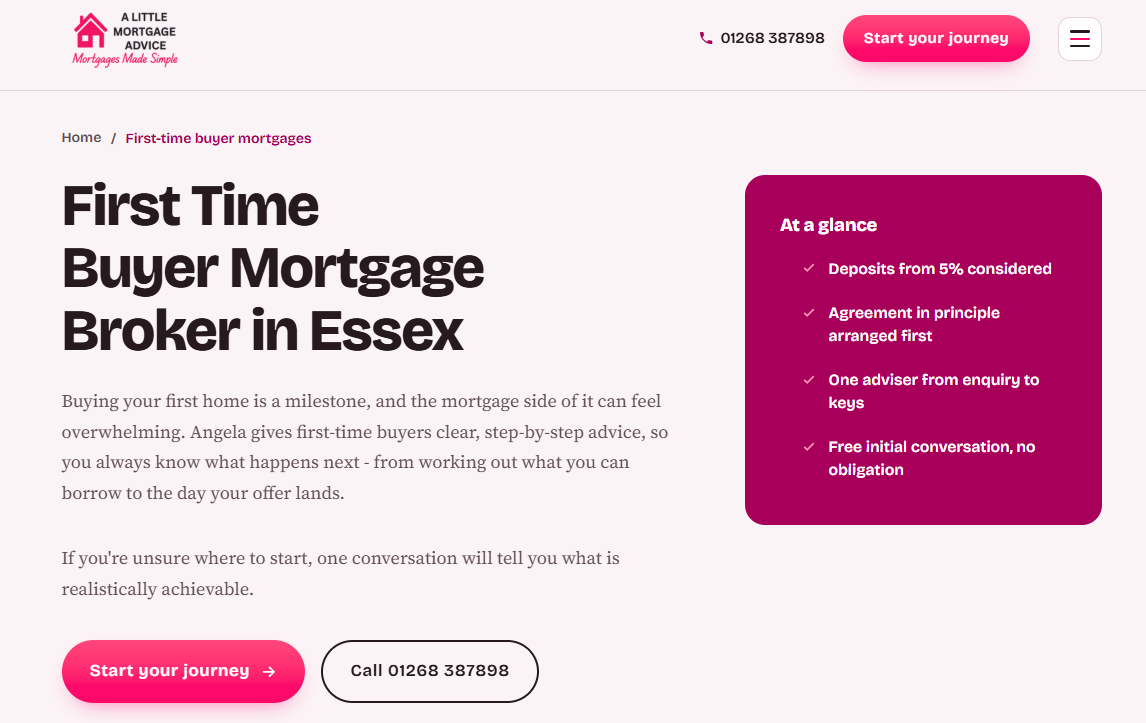
A Little Mortgage Advice leads this shortlist because its first-time buyer service centres on continuity. Its published approach gives you one adviser from the initial enquiry through to completion, with help establishing your budget before you commit to a property. First-time buyer service.
A Little Mortgage Advice’s first-time buyer service. Screenshot captured 22 September 2026.
Who is behind A Little Mortgage Advice?
The brokerage was founded by Angela Little and is based in Benfleet, Essex. Angela’s published profile records more than 30 years in financial services, over a decade advising on mortgages and a CeMAP qualification gained in 2014. She established the business in September 2019 after working at specialist mortgage brokerages.
That background is relevant if your first application involves more than a regular salary and an established credit history. Her listed areas include adverse credit, company directors and self-employed borrowers, alongside first-time buyers and remortgages. Angela Little’s adviser profile.
Why does it lead this shortlist?
For a first purchase, the usefulness of an adviser often comes down to the questions you can ask along the way. Who explains a lender’s request for more documents? Who checks whether a change in your circumstances affects the application? Who tells you what still needs doing?
Our preference here is for an identifiable contact who follows the case. That is the basis of this ranking; it is not a claim that A Little Mortgage Advice can secure a better rate or approval for every buyer.
Can it help with a smaller deposit or self-employed income?
The firm has dedicated guidance for 5% and 10% deposits, including family gifts and the effect of deposit size on lender choice. That makes it relevant to buyers who have saved a deposit but are unsure whether buying now or saving more would be practical. Low-deposit mortgage guidance.
Its self-employed service covers sole traders, directors and contractors. The stated approach is to match lenders to how the applicant earns and pays themselves. This is useful to explore when a simple salary-based calculator does not reflect your finances. The firm also states that it advises clients across the UK. Self-employed mortgage service.
What support does the service include?
Its first-time buyer page describes an initial assessment, an agreement in principle, preparation of the full application and contact with the lender as the case progresses. The conveyancer handles the legal work; the broker keeps the mortgage application moving.
Strengths
A named adviser throughout the purchase.
A founder with an established mortgage advice background.
Published support for smaller deposits and different employment circumstances.
Considerations
Confirm appointment availability and your preferred way of receiving updates.
Specialist experience does not remove a lender’s affordability or property requirements.
Our view: A sensible starting point if you want to talk through the detail of your first purchase with the same adviser. Explore its first-time buyer mortgage advice before setting your final buying budget.
2. Why consider L&C for a first-time buyer mortgage?
Our choice for buyers who put fee-free advice high on their list.
L&C offers mortgage advice without a broker advice fee and supports first-time buyers through the mortgage process. You can begin online, making it a useful comparison when you are deciding how much help you need and what you are prepared to pay for it. L&C’s mortgage advice service.
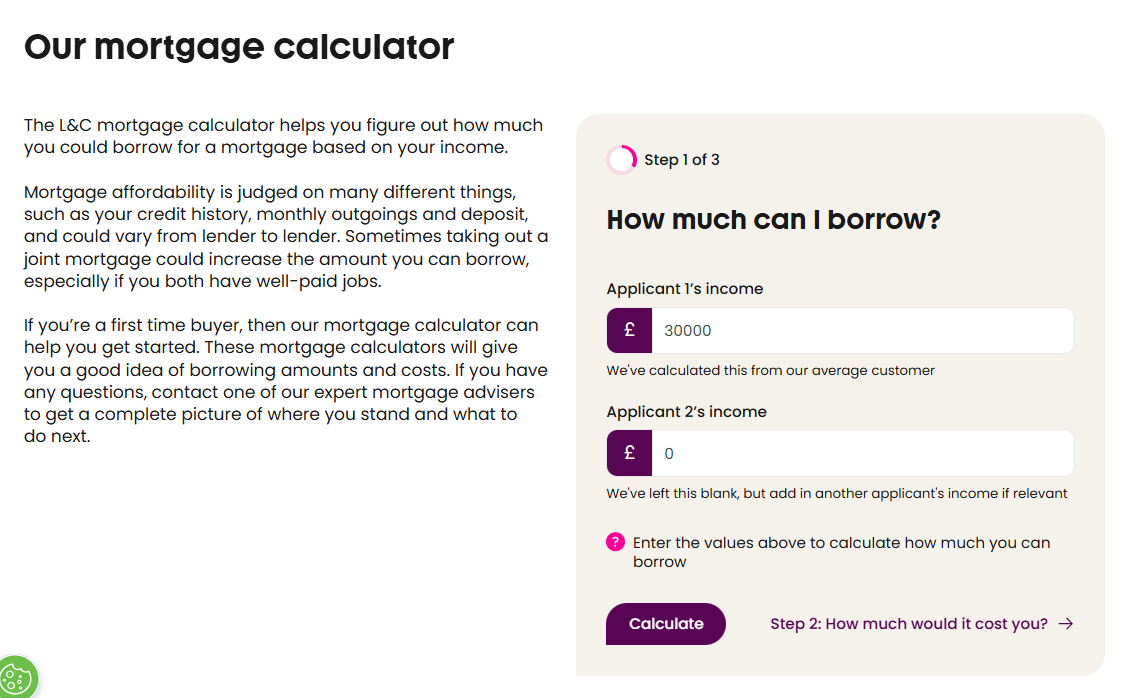
L&C’s borrowing calculator with example income fields. Screenshot captured 22 September 2026.
What can you do before speaking to an adviser?
L&C’s calculator lets you explore borrowing based on income and then estimate repayments using a loan amount, interest rate and term. For a couple buying together, the separate income fields make it easy to start with a joint illustration.
Those figures are a starting point. The calculator itself explains that credit history, outgoings and the deposit can change affordability. Its value is in helping you prepare questions: is the proposed monthly payment comfortable, and how much difference would a smaller mortgage make? L&C’s mortgage calculator.
Why is it ranked second?
Avoiding an advice fee is a clear benefit when you are paying for a purchase. We have placed adviser continuity first in this shortlist, but a buyer whose main priority is the cost of advice may reasonably start with L&C instead.
For a fair comparison, give each broker the same deposit, income and property budget. Ask them to explain the recommendation, rather than comparing only the headline rate.
Strengths
No broker advice fee.
Online tools for an initial budget discussion.
Advice and application support.
Considerations
Lender charges, legal work and survey costs are separate.
Ask who will handle your case once the application is submitted.
Our view: A useful benchmark when comparing paid and fee-free advice. The deciding question is whether the recommendation and service suit your purchase.
3. Why consider Habito for online mortgage advice?
Our choice for buyers who prefer to start digitally.
Habito combines an online starting point with mortgage advisers. Its published broker guide describes a free service searching thousands of deals from more than 90 lenders. That gives buyers a route into advice without starting with a branch appointment. Habito’s mortgage broker service.
Habito’s guide to how mortgages work. Screenshot captured 22 September 2026.
What makes it relevant to a first purchase?
Habito also publishes explanations of deposits, loan-to-value and different mortgage types. Its “How do mortgages work?” guide is a useful introduction if you want to understand the terminology before discussing a recommendation. Habito’s mortgage guide.
For a new buyer, a useful test of any online service is whether you can get a clear answer when the standard form does not describe your situation. Ask how you can discuss irregular income, a gifted deposit or a change of job, and how those details will reach the adviser reviewing your case.
Why is it ranked third?
Habito offers a different starting point from the personal-contact emphasis of our lead choice. That is a matter of preference. Some buyers want to explain everything in a conversation; others would rather gather their details and begin online.
We would compare it particularly closely with L&C. Both advertise free mortgage broking, so the useful distinction is how the advice is delivered and how comfortably you can manage the application.
Strengths
Online access to mortgage advice.
A broad published lender search.
Educational material for buyers learning the basics.
Considerations
Check which communication methods are available during your application.
Confirm whether any additional service you choose has a separate charge.
Our view: Worth considering if a digital starting point suits you. Make sure you understand how to reach your adviser when a question needs more than an online form.
4. Why consider Mortgage Advice Bureau before you start viewing?
Our choice for buyers who want help preparing their budget.
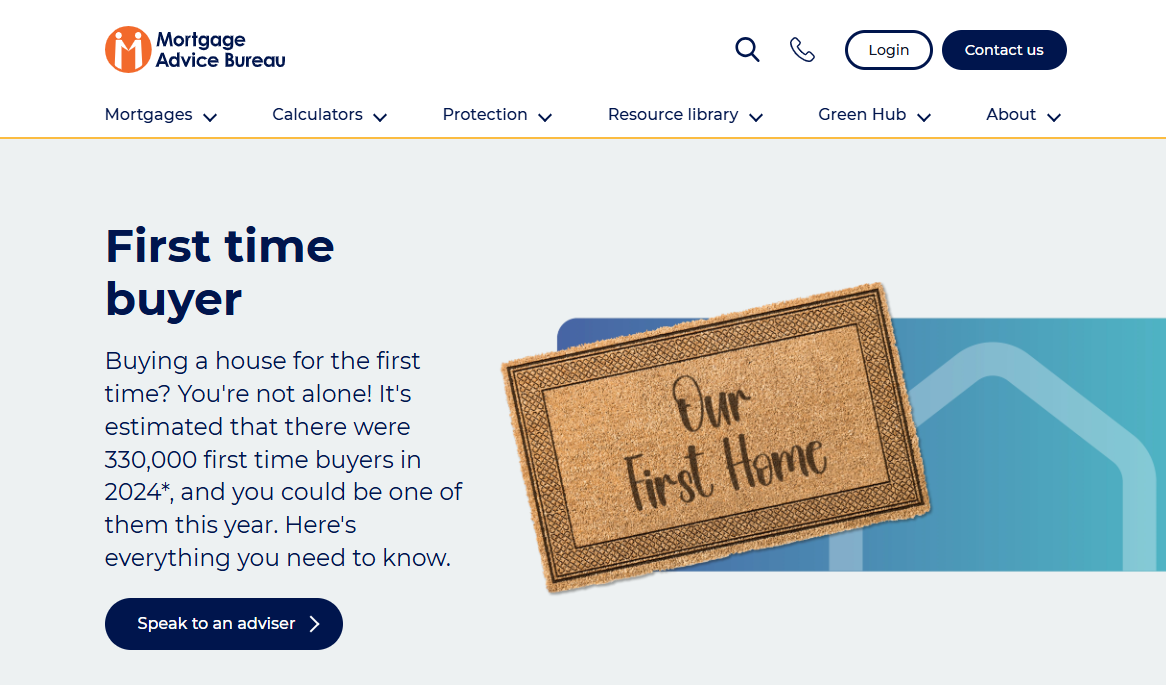
Mortgage Advice Bureau combines first-time buyer advice with tools for working out affordability and planning a purchase. Its first-time buyer page includes borrowing and affordability calculators, mortgage comparisons and the MyMAB app. Mortgage Advice Bureau’s first-time buyer service.
The practical appeal is preparation. If you are still saving, it helps to separate what you have already achieved from what remains uncertain. You may know your deposit but not your likely borrowing limit, or know the house price you want but not the monthly payment it implies.
Bring those questions to the adviser together. Ask for a budget that leaves room for your purchase costs and normal spending, and a clear explanation of what would change if you bought a less expensive property.
What should you know about the service and fees?
Mortgage Advice Bureau says its advisers recommend mortgages suited to the applicant and support the application process. Its published fee wording gives a typical charge of 0.3% of the mortgage amount, with fees up to 1%. On £200,000 of borrowing, that is £600 at 0.3% or £2,000 at 1%; your actual quote needs confirming. Mortgage Advice Bureau’s service and fee information.
Tools for exploring affordability before applying.
A planning app for buyers preparing to purchase.
Considerations
An advice fee may apply.
Confirm who will advise you and what application support is included.
Our view: A relevant option while you are preparing to buy. Its fourth position reflects the priorities of this shortlist, not a conclusion that it gives weaker advice.
5. Why consider CLS Money for a more complicated application?
Our choice for buyers who expect their circumstances to need explaining.
CLS Money offers first-time buyer advice and describes support from the initial enquiry through to completion. Its first-time buyer material covers issues such as self-employed income, recent employment changes and credit problems. CLS Money’s first-time buyer service.
The firm says its advisers and case handlers communicate with lenders and solicitors as the purchase progresses. It also describes access to specialist mortgage providers alongside mainstream options. Its homepage publishes a broker fee range of £594–£2,194, depending on circumstances. CLS Money’s service and fee information.
For a complex case, use the first conversation to establish what the broker needs to investigate. Explain the difficult parts early and ask what evidence will help. A useful response should tell you what can be assessed now and what documents are still missing.
Why is it fifth rather than higher?
This article is aimed at first-time buyers generally. CLS Money’s specialist proposition becomes more relevant when there is a specific complication to resolve. If that describes you, its position in a broad shortlist should not stop you comparing it with our lead choice.
Equally, ask what the proposed work involves before judging the fee. A service description is more useful when it explains who submits the application, who answers lender queries and who keeps you informed.
Strengths
Published support for varied income and credit circumstances.
Adviser and case-handler involvement.
Communication with other parties during the purchase.
Considerations
Request the fee for your case and the payment schedule.
Establish what happens if the lender declines or the purchase falls through.
Our view: Include it in your comparison if you need someone to assess a complication, rather than simply illustrate a borrowing amount.
Do first-time buyers need a mortgage broker?
No. You can apply directly to a lender. A broker can compare lenders, explain your options and help with the application. Advice can be particularly useful if you have a small deposit, recently changed jobs or earn your income through self-employment. MoneyHelper: mortgage advisers.
How much deposit does a first-time buyer need?
Many first-time buyer mortgages start at a 5% deposit, although some products have different requirements. On a £200,000 property, 5% is £10,000. A larger deposit reduces what you borrow and may improve the rates available. Keep money aside for purchase costs too. MoneyHelper: first-time buyers.
What difference does a larger deposit make to the loan amount?
For a £250,000 home, the arithmetic looks like this:
Deposit percentage
Cash deposit
Mortgage needed
Loan-to-value
5%
£12,500
£237,500
95%
10%
£25,000
£225,000
90%
15%
£37,500
£212,500
85%
These figures show how much of the purchase price is borrowed. They do not indicate what a lender will approve. Keep your legal, survey and moving budget separate when deciding how much cash you can put into the deposit.
How much can a first-time buyer borrow?
Your borrowing limit depends on your income, spending, debts and the lender’s affordability checks. Two buyers earning the same salary can receive different offers. Ask a broker to assess your circumstances before setting your property budget. MoneyHelper: mortgage applications.
What documents will a mortgage broker need?
Usually, you will need photo ID, proof of address, recent payslips, bank statements and evidence of your deposit. Self-employed buyers may need accounts and tax calculations. A gifted deposit usually needs supporting evidence. Your broker should confirm the exact requirements for the lender. MoneyHelper: application documents.
Can you buy your first home with bad credit?
It may be possible. The type of credit problem, how recently it happened and your wider finances affect your options. A broker who handles these cases can assess which lenders may consider you. Approval and rates will depend on the lender’s checks. A Little Mortgage Advice: credit issues.
When should you speak to a mortgage broker?
Speak to a broker before you commit to a property budget. An early conversation can identify what you need to save, which documents to prepare and any issues to address. You can compare more than one firm’s service and fees before choosing. MoneyHelper: when to seek advice.
What should you ask before choosing a broker?
What will I pay, and when is the fee due?
Which lenders and mortgage types do you consider?
Who will manage my application?
Have you handled buyers with circumstances like mine?
What support is included after I apply?
What happens to the fee if the purchase falls through?
For advice from one person throughout your first purchase, start by asking A Little Mortgage Advice to review your budget, deposit and credit history.
This guide provides general information, not a personal mortgage recommendation. Your home may be repossessed if you do not keep up repayments on your mortgage.